


How to hire and retain great dance instructors: 12 strategies to build a successful teaching team
To hire dance instructors who suit your studio, start with a clear staffing plan, a specific job description, structured interviews and a practical teaching audition. To keep them, offer fair pay, proper onboarding, predictable schedules and room to grow.

Great dance instructors are one of the most valuable assets a dance studio can have.
They do much more than teach choreography and technique. They influence the quality of your programmes, shape the experience students have in your classes, build relationships with families and contribute to your studio's reputation.
A talented instructor can help students develop their skills, feel confident and enjoy coming back every week. On the other hand, frequent instructor changes, inconsistent teaching quality or poor communication can affect student satisfaction and make it harder to retain members.
As your dance studio grows, building a reliable teaching team becomes increasingly important. You might start by teaching every class yourself, but eventually you may need additional instructors to introduce new dance styles, open more sessions or accommodate increasing student numbers.
Finding the right people is only half the challenge. You also need to create an environment where instructors feel supported, fairly compensated and motivated to stay.
In this guide, we explore 12 strategies to help you recruit, develop and retain great dance instructors while building a stronger teaching team for your dance school.
1. Identify your staffing needs before you hire dance instructors
Before publishing a job advertisement, understand exactly what your studio needs.
Hiring an instructor without a clear role in mind can lead to scheduling problems, unnecessary payroll costs and unclear responsibilities.
Start by reviewing your current timetable and identifying the classes you need to cover.
Questions to ask before you recruit
- Which dance styles do you currently offer?
- Which classes have high demand?
- Are there programmes you cannot introduce because you lack suitable instructors?
- Do existing teachers have availability for additional sessions?
- Do you need full-time, part-time or occasional instructors?
- Are you planning to open another location?
- Do you need specialists for workshops, competitions or performances?
Example: two studios, two different needs
For example, a children's dance school might need an additional ballet teacher for weekday afternoons, while an adult salsa studio might be looking for an instructor who can teach beginner and intermediate classes on evenings and weekends.
Create a simple staffing plan that connects your teaching requirements to your business objectives.
Hire for a need, not for availability
Avoid recruiting simply because a candidate is available. Your next instructor should fill a genuine need or create a valuable opportunity for your studio.
2. Write a clear and attractive dance instructor job description
A good job advertisement helps attract suitable candidates and discourages applications from people whose availability or experience does not match your requirements.
Avoid vague advertisements such as "Dance instructor wanted" without explaining what the position involves.
Include the following information:
What to include | Details |
|---|---|
Dance styles | Specify whether you are looking for a ballet, jazz, contemporary, hip-hop, salsa or other specialist instructor. |
Student age groups | Explain whether the classes are for young children, teenagers, adults or advanced dancers. |
Experience and qualifications | Describe the relevant teaching experience, technical knowledge and any required qualifications. |
Schedule | Include expected teaching days, times and approximate weekly hours. |
Responsibilities | Explain whether instructors will only teach classes or also prepare choreography, organise performances, communicate with parents or assist with events. |
Compensation | Where possible, indicate the pay range or payment structure. |
Location | Include the studio location and any other teaching locations. |
Application process | Explain what candidates should submit, such as a CV, teaching experience, qualifications, references or demonstration video. |
You should also describe your studio's teaching philosophy and the type of environment you want to create.
Candidates are choosing too
Talented instructors are evaluating your studio too. A professional and transparent job advertisement helps establish trust from the beginning.
3. Recruit through the right channels
Posting a job advertisement on one general recruitment website might not be enough to find the right dance instructor.
You should consider several recruitment channels, particularly those that connect you directly with the dance community.
Useful options include:
Channel | How to use it |
|---|---|
Dance schools and academies | Contact established dance schools and training programmes that might know qualified instructors or recent graduates looking for teaching opportunities. |
Dance universities and colleges | Build relationships with performing arts programmes and institutions offering dance education. |
Professional dance networks | Advertise through relevant dance organisations, associations and professional communities. |
Social media | Publish opportunities on Instagram, Facebook and relevant local dance groups. |
Existing instructors | Ask your current teachers whether they know experienced dancers who might be interested. |
Student and alumni networks | Former students who have developed into capable dancers and teachers might become future instructors. |
Industry events | Attend dance festivals, workshops and professional events where you can meet potential candidates. |
Grow teachers from within
You can also develop an internal pathway for assistant teachers.
For example, experienced students might gradually move into supervised assistant roles and receive appropriate training before becoming instructors.
This creates an opportunity to develop talent from within your own dance community.
One process for every applicant
Always use a consistent recruitment process, regardless of where an application comes from.
4. Evaluate teaching ability, not just dancing ability
One of the most important hiring mistakes is assuming that an excellent dancer will automatically become an excellent teacher.
Performing and teaching require different skills.
Someone might have an impressive competitive background or professional performance experience but struggle to explain techniques clearly or manage a group of beginners.
When evaluating candidates, look beyond their dance achievements.
Consider:
Skill | What to look for |
|---|---|
Technical knowledge | Do they understand the techniques and principles of the dance styles they teach? |
Communication | Can they explain movements clearly and adapt explanations to different abilities? |
Class management | Can they organise a group, manage time and maintain an appropriate learning environment? |
Adaptability | Can they adjust exercises for beginners, advanced students and different age groups? |
Motivation | Do they create an encouraging atmosphere that helps students develop confidence? |
Professionalism | Are they reliable, organised and respectful towards students, parents and colleagues? |
For children's programmes, the ability to communicate patiently and create an age-appropriate learning environment is particularly important.
For advanced training, you may place greater emphasis on technical expertise, performance preparation and specialist experience.
The best dancer is not always the best hire
The best candidate is not necessarily the most accomplished dancer. It is someone who can deliver an excellent learning experience to the students your studio serves.
5. Conduct structured interviews
An interview gives you an opportunity to understand how a candidate thinks, communicates and approaches teaching.
Prepare a consistent set of questions so that you can evaluate candidates fairly.
Some useful dance instructor interview questions include:
About their teaching experience
- Which dance styles and age groups have you taught?
- How do you structure a typical beginner class?
- How do you adapt your teaching for students with different abilities?
- How do you evaluate student progress?
About their teaching philosophy
- What makes a successful dance class?
- How do you encourage students who lack confidence?
- How do you handle students who struggle with particular techniques?
- How do you balance discipline with creating an enjoyable environment?
About practical situations
- How would you handle a student who repeatedly disrupts a class?
- What would you do if a parent disagreed with a teaching decision?
- How would you respond if you could no longer attend a scheduled class?
- How do you communicate with studio management about problems?
About professional expectations
- What days and times are you available?
- Are you interested in regular weekly classes or occasional workshops?
- What are your professional development goals?
- What support would help you teach effectively?
Pay attention to how candidates explain their decisions, not just whether their answers sound impressive.
Compare candidates on the same criteria
A structured interview also helps you compare candidates using consistent criteria rather than relying entirely on intuition.
6. Arrange a practical teaching audition
An interview tells you what a candidate believes about teaching. A practical audition allows you to observe how they actually teach.
This is particularly important when recruiting dance instructors.
Ask shortlisted candidates to prepare a short demonstration class suitable for the age group and experience level they would be teaching.
For example, you might ask a ballet instructor to demonstrate a beginner class introduction or a hip-hop instructor to teach a short choreography sequence.
What to evaluate
- How they introduce themselves.
- Whether instructions are clear.
- How they organise the class.
- Their knowledge of technique.
- How they demonstrate movements.
- How they correct mistakes.
- Their interaction with students.
- How they manage time.
- Their ability to adapt when students struggle.
Run auditions fairly
Where appropriate, use a mock class or a properly supervised demonstration rather than asking candidates to teach paying students without a clear arrangement.
Pay candidates fairly for substantial audition work.
You can also ask them to explain why they structured the lesson in a particular way.
This gives you insight into their teaching approach and ability to reflect on their own practice.
A successful audition should demonstrate more than choreography knowledge. It should show that the instructor can create a positive and productive learning experience.
Compare candidates with an interview scorecard
Once you have interviewed and auditioned your shortlist, score every candidate against the same criteria. Keep each candidate's details, interview answers, audition assessment, reference check notes, overall evaluation and hiring decision together.
Evaluation criterion | Suggested weighting |
|---|---|
Dance technique and expertise | 25% |
Teaching and communication skills | 25% |
Class management | 15% |
Experience with target age groups | 15% |
Reliability and professionalism | 10% |
Cultural fit and collaboration | 10% |
Total | 100% |
Some requirements are not scored
The weightings are an illustrative framework: adapt them to the role. Treat safeguarding and legal eligibility to work as essential requirements where they apply, not as criteria that a high overall score can make up for.
7. Check references, qualifications and safeguarding requirements
Before making a final decision, verify the information provided by the candidate.
Checks to complete
Depending on the role and the programmes you operate, checks may include:
- Employment or teaching references.
- Relevant dance qualifications.
- Professional training.
- Previous teaching experience.
- Identity and eligibility to work, where applicable.
- Relevant background screening.
- Safeguarding training.
- First-aid training, where required or appropriate.
For studios teaching children, safeguarding deserves particular attention.
Understand the applicable requirements in your jurisdiction, including background checks, supervision, reporting procedures and safeguarding responsibilities.
For example, dance teachers working with children in different countries may be subject to different criminal record checking systems and eligibility requirements.
In the UK, relevant guidance and checking arrangements can depend on the role and activity. In other countries, different authorities and screening procedures apply.
Checks do not cross borders automatically
Do not assume that a qualification or background check from one country automatically satisfies the requirements of another.
Establish written safeguarding policies and make sure all relevant staff understand them.
Also verify qualifications and professional credentials rather than relying solely on statements in a CV or social media profile.
A careful recruitment process protects your students, staff and studio.
8. Offer fair compensation and clear working agreements
Compensation is one of the most important factors influencing instructor recruitment and retention.
Talented instructors often work with several studios, teach private lessons or combine teaching with performance and other professional activities.
Your compensation structure needs to recognise the value of their work while remaining financially sustainable for your business.
Common payment arrangements include:
Arrangement | How it works |
|---|---|
Hourly payment | Instructors receive an agreed amount for each teaching hour. |
Per-class payment | Teachers receive a fixed amount for delivering each class. |
Salary | Instructors receive a regular salary under the applicable employment arrangement. |
Session or project payment | Suitable for workshops, guest masterclasses or special performances. |
Additional responsibilities | Separate compensation can be agreed for choreography, recital preparation, rehearsals, administration or other work outside regular teaching. |
Example: one teacher, two kinds of work
For example, an instructor teaching a weekly class might receive a fixed payment per session, while someone preparing choreography for a major performance might receive a separate fee.
Be transparent about expectations.
What the working agreement should explain
- Payment arrangements.
- Teaching responsibilities.
- Expected working hours.
- Scheduling and availability.
- Cancellation procedures.
- Preparation and rehearsal requirements.
- Confidentiality and data handling.
- Applicable employment or contractor arrangements.
- Other agreed benefits and responsibilities.
Contractor or employee?
Do not assume that calling someone an independent contractor determines their legal status. Employment classification and associated obligations depend on local law and the actual working relationship.
Also account for the additional time instructors might spend preparing lessons, attending meetings or participating in studio events.
A fair and transparent arrangement creates a much stronger foundation than offering an attractive hourly rate while leaving other expectations undefined.
9. Create a structured onboarding process
Hiring an instructor is only the beginning.
Even an experienced teacher needs to understand how your studio operates, what you expect from classes and how to work with your students.
Create an onboarding process for every new team member.
It should cover:
Topic | What to cover |
|---|---|
Studio introduction | Explain your school's values, teaching philosophy and programmes. |
Class expectations | Describe lesson duration, class structure, preparation and student management. |
Policies | Explain attendance, safeguarding, communication, cancellations and relevant operational procedures. |
Administrative systems | Show instructors how to view their schedules, access class information and record attendance. |
Staff communication | Explain how they should communicate with managers and other instructors. |
Student experience | Introduce the age groups, learning levels and general expectations of your programmes. |
Set up their access before their first class. In Stepsi, you add staff and set their permissions, so a new teacher sees only their assigned classes and the areas of the dashboard their role needs.

Pair new teachers with a mentor
It can also be useful to assign a more experienced instructor as a mentor during the first few weeks.
Where appropriate, arrange classroom observations or opportunities to co-teach.
A structured introduction reduces misunderstandings and helps new teachers feel part of the team sooner.
Do not expect instructors to discover your studio's procedures through trial and error.
10. Build a positive teaching culture and communication process
A successful teaching team needs more than individual talent.
Instructors should feel that they are part of an organised, supportive environment where they can raise concerns, share ideas and work towards common goals.
Communication plays a major role in creating that environment.
Establish clear channels for
- Schedule announcements.
- Time-off requests.
- Class changes.
- Teaching resources.
- Student-related concerns.
- Team meetings.
- Feedback and suggestions.
Avoid expecting instructors to monitor several different messaging platforms for important information.
Use a clear central process and establish reasonable communication expectations.
Regular team meetings can also help instructors exchange ideas and discuss what is happening across different programmes.
Example: sharing what you see
For example, a ballet instructor might share observations about a student's progress that are useful to another teacher who works with the same student in a different class.
Encourage collaboration without creating unnecessary meetings.
A positive teaching culture also requires mutual respect.
Studio owners should communicate expectations clearly, listen to concerns and recognise the contribution instructors make to the business.
When teachers feel respected and included, they are more likely to develop a lasting relationship with your school.
11. Invest in professional development and career progression
Great instructors want opportunities to continue learning and improving.
Even experienced teachers can benefit from professional development, new teaching methods and exposure to different dance styles.
Support your team through
- Dance teacher training programmes.
- Specialist workshops.
- Professional conferences.
- Masterclasses.
- Safeguarding and relevant safety training.
- Classroom management training.
- Coaching and communication development.
- Opportunities to observe other instructors.
Roles an instructor might grow into
- Senior instructor.
- Programme coordinator.
- Head of ballet.
- Artistic director.
- Competition programme lead.
- Instructor mentor.
- Location manager.
Not every teacher wants a management role. Some prefer to focus on teaching and developing their technical expertise.
Offer different development paths that reflect individual ambitions.
Professional development benefits your studio too.
Teachers who continue improving can introduce new programmes, strengthen the quality of existing classes and help your business develop a stronger reputation.
Set a training budget
Where possible, include a professional development budget or agree on support for relevant training.
12. Retain great instructors through recognition, feedback and sustainable workloads
Recruitment becomes expensive and time-consuming when good instructors leave regularly.
Retaining an experienced teacher is often better than repeatedly searching for replacements, onboarding new staff and rebuilding relationships with students.
Develop a retention strategy that focuses on the everyday experience of working at your studio.
Recognise good work
Acknowledge teaching achievements, positive student feedback, successful performances and long-term commitment.
Recognition does not always need to be financial. A personal thank-you, professional acknowledgement or opportunity to lead a new programme can be meaningful.
Review compensation regularly
Make sure your payment arrangements remain fair relative to responsibilities, experience and local market conditions.
Manage workloads
Avoid consistently assigning too many classes to instructors without considering preparation, travel and recovery time.
Provide schedule stability
Give reasonable notice of changes and avoid unnecessary last-minute timetable adjustments. Our guide on how to manage dance instructor schedules covers availability, time off and last-minute changes.
Ask for feedback
Have regular individual conversations about workload, satisfaction, resources and professional goals.
Support work-life balance
Respect agreed availability and communication boundaries. Avoid expecting instructors to be available outside their agreed working arrangements.
Create opportunities for progression
Give experienced instructors opportunities to develop new programmes, mentor others or take on suitable additional responsibilities.
You should also pay attention to early signs of dissatisfaction, such as repeated schedule conflicts, reduced engagement or concerns about compensation and workload.
Do not wait for a resignation
Do not wait until an instructor resigns to find out that they have been unhappy for months.
Hold structured reviews
Consider conducting structured reviews once or twice a year.
Ask what is working well, what could improve and what support they need to continue working effectively.
If an instructor does decide to leave, handle the process professionally. Understand their reasons, plan a smooth transition and ensure students are informed appropriately.
A healthy studio culture is built through consistent management practices, not occasional gestures when someone is considering leaving.
Common mistakes when hiring and managing dance instructors
Do
- Assess teaching ability, communication and professionalism.
- Write specific job descriptions with schedules, responsibilities and pay.
- Watch candidates teach in a practical audition.
- Check references, qualifications and safeguarding, particularly for children's classes.
- Put payment arrangements in writing.
- Onboard every new instructor, however experienced.
- Give reasonable notice of schedule changes.
- Support training and career progression.
- Ask for feedback regularly.
Avoid
- Hiring based only on performance achievements. Teaching ability, communication and professionalism are equally important.
- Having vague job descriptions. Candidates need to understand responsibilities, schedules and compensation.
- Skipping practical auditions. A teaching demonstration provides information that an interview alone cannot.
- Ignoring references and safeguarding. Thorough checks are essential, particularly when working with children.
- Offering unclear payment arrangements. Instructors should understand exactly how their work is compensated.
- Failing to onboard new staff. Even experienced instructors need to understand your studio's expectations and processes.
- Changing schedules constantly. Unnecessary uncertainty can frustrate teachers and affect their commitment.
- Ignoring professional development. Teachers need opportunities to develop their skills and careers.
- Waiting until someone resigns to address problems. Regular feedback helps identify dissatisfaction earlier.
How Stepsi helps you manage your dance teaching team
Recruiting great instructors is only one part of building a successful teaching team. You also need a reliable way to organise their schedules, responsibilities, availability and day-to-day studio operations.
Stepsi includes instructor management and staff administration features designed to help dance studios coordinate their teaching teams.
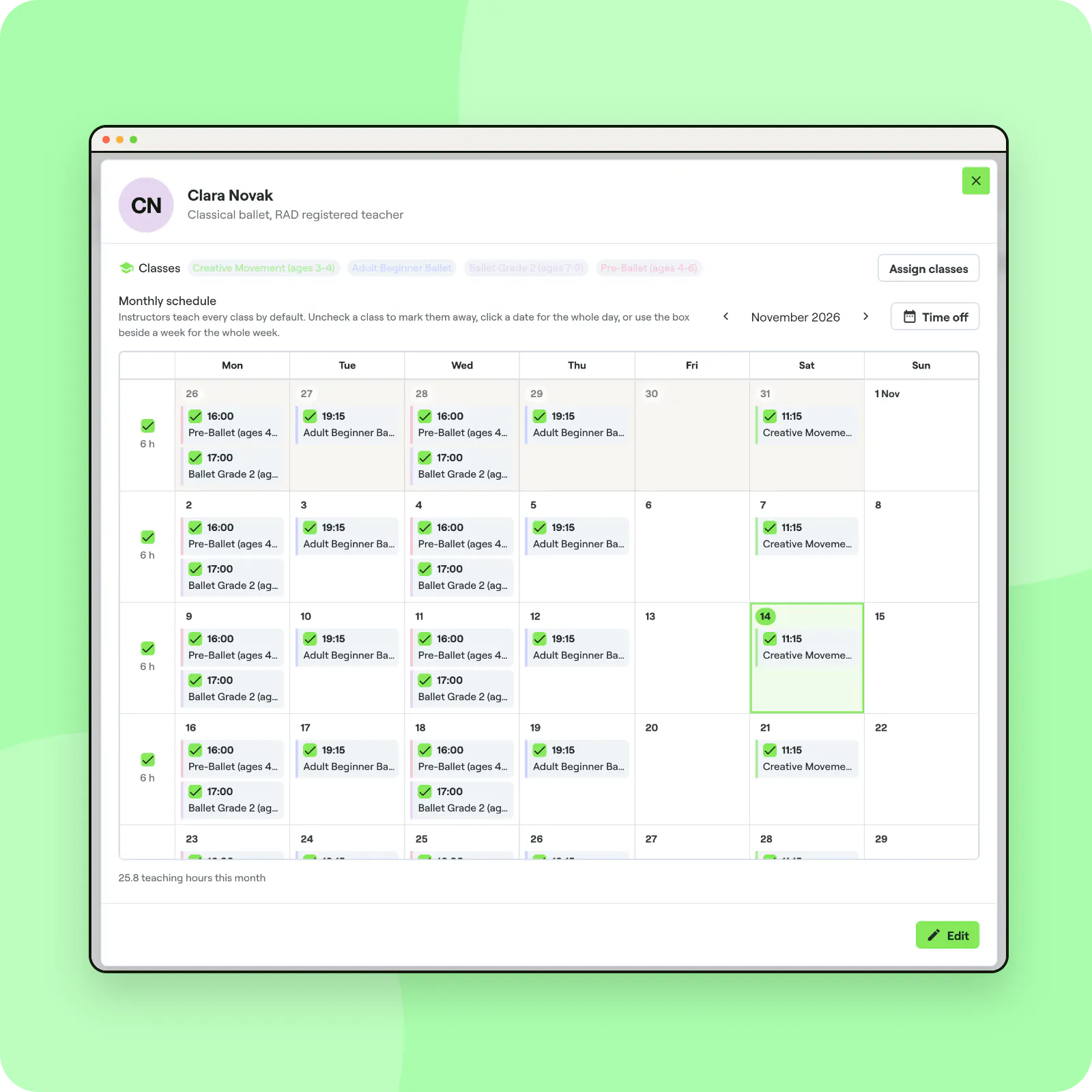
With Stepsi, you can:
Instructors and schedules
- Create instructor profiles with photographs.
- Assign instructors to specific classes.
- View weekly and monthly teaching schedules.
- Track scheduled teaching hours.
- Mark instructors as teaching or unavailable.
Time off and changes
- Manage time off for individual instructors or selected classes.
- Identify classes affected by staff absences.
- Notify affected students and parents about schedule changes.
- Manage class cancellations and booking changes.
Access and insights
- Give instructors access to their own classes.
- Restrict staff to selected calendars.
- Configure permissions for members, memberships, calendars, check-in and payments.
- Review attendance and revenue by instructor.
Stepsi also supports staff payout workflows. Staff can request payments by bank transfer or card, instructors can have their own Stripe accounts, and administrators can manage payments through the platform.

This helps connect instructor management with the financial administration of your dance studio, although local employment, payroll, tax and accounting obligations still need to be managed appropriately.
Instead of coordinating everything through separate calendars, spreadsheets and messages, you can give instructors and administrators access to the information relevant to their responsibilities.
Your whole teaching team, organised
By connecting teaching schedules with members, classes, attendance and administrative permissions, Stepsi helps your team operate from one organised platform.
Final thoughts
Building a successful dance studio requires more than finding talented people who can teach your classes.
You need instructors who communicate well, understand your students, support your teaching philosophy and want to develop alongside your business.
Start with a clear staffing plan, write specific job descriptions and use structured interviews, teaching auditions and appropriate background checks to find the right candidates.
Once you hire them, invest in proper onboarding, fair compensation, professional development and a positive working environment.
Most importantly, remember that retaining great instructors requires ongoing attention. Listen to their feedback, respect their time and recognise the contribution they make to your studio.
Your instructors are not simply people who fill spaces on your timetable. They are the people who bring your dance school's identity, teaching philosophy and community to life. Build a team that feels valued, and your students will benefit too.
Frequently asked questions
How do I find qualified dance instructors?
Start by defining the experience and teaching skills you need. Advertise through professional dance networks, universities, dance schools, social media and industry contacts. Evaluate candidates through interviews, teaching demonstrations and relevant checks.
What qualifications should a dance instructor have?
Requirements depend on the dance style, age group, programme and local regulations. Look for relevant professional training, teaching experience, technical knowledge and any required safeguarding or other credentials.
How much should I pay a dance instructor?
Compensation depends on location, experience, qualifications, responsibilities and the type of work. Compare local rates and calculate what your studio can sustainably afford. Account for preparation, rehearsals and other agreed responsibilities.
How can I retain good dance instructors?
Provide fair compensation, predictable schedules, good communication, professional development, recognition and opportunities for progression. Regularly ask instructors about their workload and job satisfaction.
Should dance instructors have access to studio management software?
Yes, where it supports their responsibilities. Instructors may need access to their own schedules, class lists and attendance records. Use role-based permissions to keep financial and other sensitive information restricted.


