


How to price dance classes: 12 strategies to create profitable pricing plans
To price dance classes profitably, work out what each class costs and how many paying students it needs to break even, then build memberships, term fees, packages and discounts on top. This guide covers 12 strategies, with worked examples and a free calculator.

Setting the right prices for your dance classes is one of the most important decisions you will make as a studio owner.
Charge too little, and you might struggle to cover instructor salaries, studio rent, utilities and other operating expenses. Charge too much without clearly communicating the value of your classes, and potential students might choose another dance school or decide not to register at all.
Finding the right balance requires more than looking at what competing studios charge. You need to understand your costs, class capacity, target audience, membership structure and the value you provide to students.
Whether you run a children's ballet school, an adult salsa studio, a competitive dance academy or a multi-style dance school, a well-designed pricing strategy can help you attract students while maintaining healthy profit margins.
The good news is that you do not need to use one pricing model for every class. You can combine term-based tuition, monthly memberships, prepaid packages, drop-in payments, family discounts and premium programmes to accommodate different students and attendance patterns.
In this guide, we explore 12 strategies to help you price your dance classes, create profitable membership plans and build a financially sustainable dance studio.
1. Calculate your actual operating costs before setting prices
The first step towards profitable dance class pricing is understanding how much it costs to run your studio.
Many dance schools set their prices based on what competitors charge or what parents seem willing to pay. However, a price that looks competitive does not necessarily cover your operating expenses.
Start by calculating your monthly business costs.
Typical expenses include:
- Studio rent and property costs.
- Electricity, heating and utilities.
- Instructor salaries and fees.
- Administrative staff.
- Insurance.
- Music licensing.
- Marketing and advertising.
- Dance studio management software.
- Cleaning and maintenance.
- Equipment and supplies.
- Payment processing fees.
- Accounting and other professional services.
Separate fixed and variable costs.
Fixed costs are expenses that remain relatively stable regardless of how many students attend, such as rent, software subscriptions and certain administrative salaries.
Variable costs increase as you deliver more classes or serve additional students. These might include instructor payments based on teaching hours, consumables and certain event-related expenses.
You should also allocate an appropriate share of your general operating costs to the programmes you offer.
Share the rent fairly
For example, if your studio has three rooms and each is used differently, you should not automatically assign the entire monthly rent to one popular ballet programme.
A useful approach is to calculate costs by class, programme or teaching hour.
Once you understand what your studio actually spends, you can start setting prices based on financial requirements rather than guesswork.
2. Calculate your break-even point for every class
Knowing your total operating costs is important, but you also need to understand the financial performance of individual classes.
A class can be fully booked and still generate disappointing financial results if the price is too low or the delivery costs are too high.
Calculate your break-even point: the number of paying students required to cover the costs of running a class.
Use this simplified formula:
Break-even students = Fixed class costs ÷ (Price per student − Variable cost per student)
Example: the break-even point of one class
Imagine a dance class has the following costs:
- Instructor payment: £35.
- Allocated studio and operating costs: £20.
- Other fixed class costs: £15.
- Total fixed costs: £70.
- Price per student per session: £11.
- Variable cost per student: £1.
Your contribution per student is £10. Therefore: £70 ÷ £10 = 7 students.
You need seven paying students to cover the example costs of that session.
If 10 students attend, your class generates:
Item | Amount |
|---|---|
10 students × £11 | £110 |
Fixed costs | £70 |
Variable costs | £10 |
Remaining contribution | £30 |
This example excludes any costs not included in the calculation, such as additional taxes or unallocated overheads.
Perform this calculation for your different programmes.
A children's ballet class, an adult salsa session and a competitive dance programme might have very different costs and capacity requirements.
Understanding the financial performance of each class helps you identify which programmes are sustainable and which need changes to pricing, scheduling or capacity.
3. Consider class capacity and expected attendance
One of the biggest mistakes dance studio owners make is pricing classes without considering how many students can realistically attend.
Your studio might have enough space for 20 students, but that does not mean every class will regularly have 20 paying participants.
Consider three different numbers:
Maximum capacity: The highest number of students you can reasonably accommodate.
Expected attendance: The number you realistically expect to have in a typical session.
Break-even attendance: The minimum number of paying students needed to cover the relevant costs.
These numbers help determine whether a proposed price is sustainable.
For example, a small contemporary class might have a maximum capacity of 10 students, while a larger recreational hip-hop class can accommodate 20.
The smaller class may need a higher price per student to cover its teaching and operating costs.
Also consider the learning experience.
A specialist ballet technique class may justify smaller groups and higher pricing because students receive more individual attention.
Do not automatically increase capacity just to reduce the apparent cost per student. Overcrowded classes can undermine teaching quality, safety and student satisfaction.
Your pricing should support the experience you want to provide.
Cap each class at the size you priced it for
In Stepsi, every class has its own capacity, and students who find a class full can join a waiting list instead of squeezing in.
4. Research competitor prices in your local market
Understanding local competition is an important part of creating a realistic pricing strategy.
Parents and adult students often compare several dance schools before deciding where to register.
Look at studios operating in your area and compare similar programmes.
Research:
- Monthly membership prices.
- Term tuition fees.
- Individual class prices.
- Private lesson rates.
- Workshop prices.
- Registration fees.
- Family and sibling discounts.
- What is included in each membership.
Make sure you compare equivalent services.
For example, a small ballet studio offering 45-minute classes with eight students should not be compared directly with a large dance academy offering 90-minute sessions and additional facilities.
Look beyond the displayed price.
Consider the instructor experience, class duration, facilities, performance opportunities, teaching approach and overall customer experience.
You may find that competitors offer lower prices but fewer additional services.
Alternatively, a premium dance academy might charge considerably more because of specialist training and its reputation.
The objective is not necessarily to be the cheapest studio.
It is to understand what customers expect to pay in your market and position your classes appropriately.
You can use your research to identify opportunities for differentiation, especially when your studio offers specialist programmes or a more personalised experience.
5. Price according to the value of your classes, not just your costs
Cost-based pricing tells you the minimum amount you need to charge. It does not necessarily tell you the best price for your services.
Consider the value your dance studio provides.
A specialist ballet programme led by experienced instructors may offer more than a general recreational class.
A competitive dance programme might include additional coaching, performance preparation and structured progression.
A beginner adult salsa class could offer a welcoming social environment and opportunities to participate in dance events.
These services have different value propositions and should not automatically share the same price.
Consider factors such as:
- Instructor qualifications and experience.
- Dance style and level of specialisation.
- Class duration and frequency.
- Maximum group size.
- Individual attention.
- Training facilities.
- Performance opportunities.
- Additional learning resources.
- Location and convenience.
- Reputation of the studio.
This is where value-based pricing becomes important.
Instead of asking only how much it costs to deliver a class, ask what makes the experience valuable to your students and families.
For example, a specialist competition programme might justify a higher price than a general recreational class because it requires additional preparation and more individual instruction.
Make sure your marketing communicates these differences clearly.
A premium price needs to be supported by a premium experience.
6. Choose the right payment model for each dance programme
Different dance programmes require different payment structures.
Some students prefer to pay for a full term, while others want the flexibility of monthly memberships or individual class bookings.
Offering several payment options allows you to accommodate different needs without creating unnecessary complexity.
Consider these models:
Term-based tuition
Students pay for a fixed number of weekly sessions over a school term.
This is particularly suitable for children's dance schools and structured programmes.
For example, a 12-week ballet term could be sold for £180.
Monthly memberships
Students pay a recurring monthly fee for access to selected classes.
This works well for studios with regular weekly programmes and ongoing memberships.
Drop-in payments
Students pay for individual classes without committing to a membership.
This is particularly useful for open adult classes and occasional participants.
Prepaid class packages
Students purchase a specific number of sessions, such as five or ten classes, and use them over a defined period.

Unlimited memberships
Members pay a recurring fee to attend a selection of eligible classes.
This can be attractive to frequent participants who want flexibility.
You can combine these models.
For example, your children's ballet programmes could use term-based tuition, while adult salsa classes offer monthly memberships and individual drop-ins.
Choosing the right payment structure makes pricing easier to understand and helps your studio accommodate different attendance patterns.
Stepsi handles each of these models as a price plan. For collecting the payments, see how to set up recurring payment plans for dance studios.
7. Introduce tiered membership plans
Instead of offering one price for everyone, create several membership tiers.
This allows students to choose a plan that suits their budget, attendance frequency and interests.
For example, an adult dance studio might offer:
Plan | Included access | Illustrative monthly price |
|---|---|---|
Basic | One class per week | £45 |
Plus | Two classes per week | £75 |
Unlimited | All eligible weekly classes | £99 |
These are hypothetical prices, not market benchmarks.
The advantage of tiered pricing is that students can choose according to their needs.
Someone who attends once per week can select the basic membership, while a more committed dancer might prefer unlimited access.
Make sure the differences between plans are obvious.
Avoid creating several memberships with almost identical benefits.
You should also calculate whether unlimited memberships are financially sustainable based on expected attendance and class capacity.
An unlimited plan can be attractive to members but needs clear eligibility rules, booking restrictions and appropriate capacity management.
Review your plans regularly to ensure that popular options remain profitable. For setting up and running the plans themselves, see our guide to dance studio membership options.
8. Encourage additional bookings with multi-class packages
A student who attends one class per week might be interested in attending another dance style if the pricing makes sense.
Multi-class packages encourage students to increase participation while providing additional recurring revenue.
For example:
- One weekly class: £45 per month.
- Two weekly classes: £75 per month.
- Three weekly classes: £95 per month.
- Unlimited eligible classes: £115 per month.
The pricing should make additional attendance attractive while ensuring each package generates sufficient contribution.
You can also combine different programmes.
For example, a children's package might cover ballet and jazz, while an adult package could combine salsa and bachata. And because a dancer can hold several memberships at once in Stepsi, an extra style can also be sold as a plan of its own.
Another option is offering a shared prepaid session pool for eligible family members.
The key is to make package benefits easy to understand.
Do not discount every additional class so heavily that your revenue per student decreases unnecessarily.
A good package should encourage increased participation while improving the commercial value of each membership.
9. Create family and sibling pricing options
Family discounts are particularly important for children's dance schools.
A parent with two or three children attending different classes might be paying several separate membership fees.
Offering family pricing can make your studio more attractive to these households while encouraging additional enrolments.
For example:
- First child: standard price.
- Second child: 10% discount.
- Third child: 15% discount.
Alternatively, you could offer a family package covering selected classes for multiple children.
Couple memberships can be useful for ballroom, salsa and other partner dance programmes.
In Stepsi, a sibling discount is a member discount on the second child's profile: a percentage or an amount, an optional start and end date, and the memberships or classes it applies to. Parents manage every child from one family account.

Before introducing discounts, calculate their financial effect.
Example: a 10% sibling discount
If your standard membership costs £50 and you offer a 10% sibling discount, the discounted membership generates £45.
That may be commercially reasonable if the additional student uses otherwise available class capacity.
However, the economics are different if the class is already full and the discounted place prevents you from accepting another full-price student.
Family discounts should encourage additional participation without unnecessarily reducing the value of every membership.
10. Create premium pricing options for specialist classes
Some programmes require more teaching time, specialist expertise or additional preparation.
Rather than applying one price across your entire timetable, consider separate pricing for premium services.
Examples include:
- Advanced ballet technique.
- Competition training.
- Private coaching.
- Audition preparation.
- Specialist choreography.
- Examination preparation.
- Small-group intensive sessions.
- Guest instructor workshops.
Premium pricing should reflect the actual value and additional resources involved.
For example, a 60-minute private lesson should not necessarily cost the same per participant as a 60-minute group class.
Similarly, a specialised competition programme may require instructors to spend additional time preparing choreography, reviewing performances and supporting students.
You can sell premium programmes as separate memberships, prepaid packages or one-time bookings. Private coaching, workshops and exam preparation are also among the additional dance studio revenue streams you can add.
The most important thing is to communicate what makes these services different.
Students and parents should understand why a specialist programme costs more and what additional value they receive.
11. Use discounts and longer-term commitments strategically
Discounts can encourage registrations, but they should be used carefully.
Constantly reducing your prices can teach customers to wait for promotions rather than purchase at the standard rate.
Instead, use targeted discounts with a clear purpose.
Examples include:
Early-bird pricing: Offer a reduced rate to students who register for the upcoming term before a deadline.
Longer-term commitments: Provide a discount for students who choose three-, six- or twelve-month packages.
Renewal discounts: Reward students who continue their memberships.
Family discounts: Encourage multiple children or eligible family members to enrol.
Referral offers: Reward existing members who introduce new students.
Introductory promotions: Offer a special first-class or beginner package to reduce the barrier to joining. They work best as part of a wider plan to attract more dance students.
For example, you might offer a 5% discount for families who register for a full term before a specific date.
In Stepsi, packages sell three, six or twelve months of a membership at a price of their own, a renewal discount takes a fixed amount off every automatic renewal, and coupons with an expiry date suit early-bird offers.

Always calculate how much revenue you sacrifice and whether the offer generates sufficient additional registrations to justify it.
Also make the terms clear: which memberships qualify, how long the offer lasts and whether it can be combined with other discounts.
Avoid stacking several promotions in a way that makes the final membership price unprofitable.
12. Review your prices regularly and make changes based on data
Your pricing strategy should evolve as your dance studio grows.
Rent increases, instructor costs change, demand fluctuates and students develop different attendance patterns.
A price that was profitable two years ago might no longer cover your current expenses.
Review your pricing at least once or twice per year, or whenever your operating costs or programme structure change significantly.
Useful metrics include:
Revenue per student: How much revenue does each active member generate?
Revenue per class: Which classes generate the highest income?
Class fill rate: What percentage of available places are occupied?
Break-even attendance: How many students are needed to cover class costs?
Membership distribution: Which plans are most popular?
Renewal rate: How many students continue their memberships?
Discount usage: How much revenue is being reduced through promotional offers?
Contribution margin: How much remains after the relevant variable and allocated costs?
In Stepsi, Analytics puts revenue by class, instructor, calendar and payment method next to fill rates and attendance. See how to read your dance studio analytics.
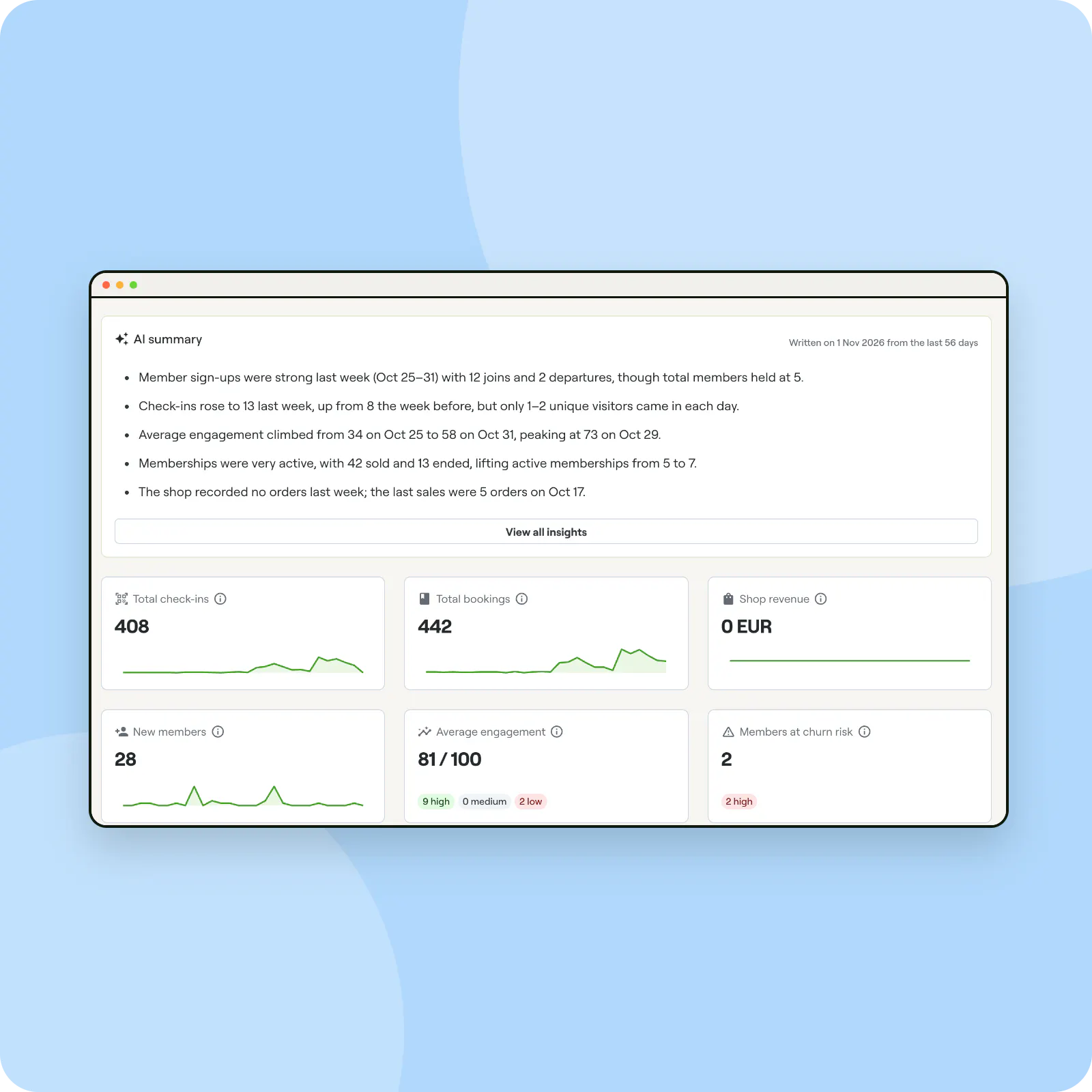
For example, you might discover that your Saturday contemporary class is consistently full while a weekday session has low attendance.
Possible solutions include reviewing the timetable, changing the class format, adjusting its pricing or consolidating sessions where appropriate.
Similarly, if your instructor costs increase, you might need to review pricing across affected programmes.
Avoid making changes based purely on intuition.
Use your financial and attendance information to understand where adjustments are necessary.
When increasing prices, communicate the reasons clearly and provide sufficient notice. Explain improvements in teaching, facilities or services where relevant, and give families time to plan. Handled well, a price change need not cost you students: see how to improve dance student retention.
Compare the ways to price dance classes
Use this overview to choose a pricing model for each of your programmes.
Pricing model | Advantages | Potential disadvantages | Best for |
|---|---|---|---|
Term tuition | Predictable enrolments and revenue | Larger upfront payment | Children's dance schools |
Monthly membership | Recurring revenue | Requires renewal management | Regular weekly programmes |
Unlimited membership | Encourages frequent participation | Requires capacity controls | Active adult dancers |
Limited-session plan | Controlled usage | Session tracking required | Flexible attendance |
Drop-in pricing | Easy for occasional students | Less predictable revenue | Adult open classes |
Private lesson package | Higher value per session | Limited instructor capacity | Specialist training |
Common dance class pricing mistakes to avoid
Do
- Calculate your own costs before you compare prices.
- Price each programme by its duration, specialisation, resources and demand.
- Set prices that work at a capacity you can teach well.
- Keep a short list of clearly different membership options.
- Work out what each promotion costs and what it should achieve.
- Include payment processing and other fees in your costs.
- Review your prices at least once or twice a year.
- Give members advance notice of important changes.
Avoid
- Copying competitor prices without calculating your costs. A competitor may have different rent, instructor expenses, class sizes and operating arrangements.
- Charging the same price for every programme. Class duration, specialisation, teaching resources and demand can differ significantly.
- Ignoring class capacity. A low price might attract registrations but create overcrowded classes and operational problems.
- Offering too many membership options. Complicated pricing makes it harder for students to choose.
- Discounting without calculating the impact. Promotions should support a commercial objective rather than simply reduce prices.
- Ignoring payment processing and other fees. Small costs can have a meaningful effect when applied to many recurring transactions.
- Not reviewing prices regularly. Rising expenses can gradually erode your margins.
- Increasing prices without communicating clearly. Give members advance notice and explain important changes.
How Stepsi helps you manage dance class pricing and memberships
Creating profitable pricing plans is easier when you can manage memberships, payments, registrations and attendance through one system.
Stepsi gives dance studio owners the flexibility to configure different pricing structures according to the way their programmes operate.
You can:
Build your price plans
- Create monthly or interval-based recurring membership plans.
- Set prices in your club's chosen currency.
- Configure whether additional fees are included in or added to the displayed price.
- Offer unlimited or limited-session memberships.
- Set session limits per week and per renewal period.
- Create prepaid packages with three-, six- or twelve-month options.
- Set memberships to cover selected classes or member groups.
Discounts, families and flexibility
- Configure commitment periods and grace periods.
- Offer family and couple memberships.
- Apply discounts to selected memberships and classes.
- Create renewal discounts.
- Allow unused sessions to carry over within configured limits.
- Manage upgrades, extensions and membership freezes.
Payments and revenue data
- Offer online purchases and suitable manual payment options.
- Track payments, refunds and invoices.
- Analyse revenue by class, instructor, calendar and payment method.
Members can purchase memberships through the public web app or mobile app, while studio administrators can manage membership assignments and payments from the dashboard.
Stepsi also connects membership entitlements to bookings and attendance, making it easier to understand how students use their plans.
Its analytics provide an overview of revenue, class performance, memberships and student activity, helping you make more informed pricing decisions.
Pricing, memberships and payments in one place
Instead of maintaining separate spreadsheets for pricing, membership status and payment history, your team can manage these activities within the same platform.
Final thoughts
Pricing dance classes profitably requires more than choosing a number that looks competitive.
You need to understand your operating expenses, calculate break-even attendance, consider class capacity and create payment models that suit your students.
Start with a clear understanding of your costs, establish appropriate membership tiers and introduce family packages, prepaid sessions and premium programmes where they make commercial sense.
Then review your pricing regularly using revenue, attendance and membership data.
Remember that the cheapest dance studio is not necessarily the most attractive one. Students and parents are also paying for teaching quality, convenience, experience and the community your school provides.
The best pricing strategy is one that makes your classes accessible to the right students while giving your dance studio the financial stability to continue growing.
Frequently asked questions
How much should I charge for a dance class?
Your price should reflect the cost of delivering the class, expected attendance, studio capacity, local market and value provided. Calculate your break-even point before deciding on a sustainable price.
How much should a dance studio charge per month?
Monthly fees vary depending on the location, number of classes, duration, teaching quality and membership benefits. Calculate your costs and research comparable local programmes before setting your own prices.
Is it better to charge per class or monthly?
Monthly memberships provide predictable recurring revenue, while individual class payments offer flexibility. Many studios use a combination of term tuition, monthly memberships, prepaid packages and drop-in bookings.
Should dance studios offer sibling discounts?
Sibling discounts can encourage families to enrol multiple children, but calculate their financial impact first. Consider offering discounts on additional memberships rather than reducing the price of every enrolment.
How often should a dance studio increase its prices?
Review prices regularly, ideally at least once or twice a year. Consider changes in operating costs, instructor payments, class capacity, competitor pricing and student demand. Communicate changes in advance.


