

How to start a dance studio: a complete guide to planning, launching and growing your dance school
To start a dance studio, choose a clear concept and audience, check local demand, write a business plan and budget, then sort out the legal side, premises, teachers, timetable, prices and systems before you market your first classes.

Starting a dance studio can be an exciting opportunity to turn your passion for dance into a sustainable business.
Whether you are an experienced dance instructor planning to open your own school or an entrepreneur looking to enter the dance education industry, running a studio gives you the opportunity to build a community, develop talented dancers and create a business around something you love.
However, opening a dance studio involves much more than finding a suitable room and starting to teach.
You need to understand your local market, choose the right business model, calculate startup costs, find suitable premises, recruit instructors, establish pricing, attract students and organise everyday administration.
Many aspiring studio owners focus heavily on the teaching side of the business but underestimate the operational and financial responsibilities involved.
A successful dance school needs both excellent teaching and effective business management.
In this guide, we explain how to start a dance studio step by step, from planning your business idea to launching your first classes and building a growing dance community.
1. Choose your dance studio concept and target audience
Before investing in premises or equipment, decide what kind of dance studio you want to create.
Your concept will influence almost every other decision, including location, teaching staff, pricing, class schedules and marketing.
Start by deciding which dance styles you want to offer.
Popular options include:
- Classical ballet.
- Contemporary dance.
- Jazz and lyrical.
- Hip-hop and street dance.
- Tap dance.
- Ballroom dancing.
- Salsa and bachata.
- Latin dance.
- Musical theatre.
- Dance fitness.
- Competitive dance training.
You do not need to offer every style when starting.
In fact, focusing on a smaller number of programmes can make it easier to establish your reputation and attract a clearly defined audience.
Next, decide who your main students will be.
For example:
Children: Ballet, jazz, contemporary and recreational dance programmes for different age groups.
Teenagers: Advanced training, choreography, performance opportunities and competition preparation.
Adults: Beginner-friendly dance classes, recreational programmes and social dancing.
Couples: Ballroom, Latin dance and wedding dance preparation.
Competitive dancers: Specialist coaching, technique development, auditions and competition training.
You can also combine several audiences. For example, a school might offer children's ballet during the afternoon and adult salsa classes in the evening.
However, avoid creating an overly complicated timetable before you understand the demand for each programme.
Start with a clear concept and expand as your business develops.
2. Research your local dance market
Before opening a dance studio, understand whether there is enough demand in your chosen area.
A great business idea is not necessarily commercially viable if the local market is already saturated or if there are not enough potential students nearby.
Start by researching existing dance schools.
Look at:
- How many dance studios operate in your area?
- Which dance styles do they offer?
- What age groups do they target?
- What are their class schedules?
- How much do they charge?
- How do students review their services?
- Do they have professional websites?
- Are their classes fully booked?
- Are there opportunities they are not currently addressing?
Do not limit your research to direct competitors.
Other activities such as gymnastics, martial arts, swimming and music schools may compete for the same children's extracurricular budgets.
For adult programmes, consider gyms, fitness classes, social clubs and other recreational activities.
You should also research your potential customer base.
Look at the population, nearby residential areas, schools, transport connections and local community facilities.
Try to identify gaps in the market.
For example, your area might have several ballet schools but very few beginner-friendly adult salsa classes.
Alternatively, existing studios might focus on competitive dance, leaving an opportunity for a recreational school with flexible programmes.
The objective is to find a specific audience that your studio can serve better than existing alternatives.
3. Write a dance studio business plan
A business plan helps turn your idea into a practical business model.
You do not necessarily need a lengthy document, but you should understand how your studio will operate and generate enough income to cover its expenses.
Your business plan should cover several areas.
Section | What to cover |
|---|---|
Business concept | Describe your studio, the dance styles you will offer, your target audience and what makes your school different. |
Market research | Summarise local demand, competitor pricing, potential customers and the opportunity you intend to pursue. |
Services and pricing | List your programmes, memberships, tuition options, private lessons and additional services. |
Premises and equipment | Explain whether you will rent existing studio space, hire community halls or lease your own premises. |
Staffing | Identify the instructors and administrative support required to operate your programmes. |
Marketing strategy | Explain how you will attract your first students and generate enquiries. |
Financial projections | Estimate startup costs, operating expenses, expected registrations, monthly revenue and break-even requirements. |
Create several financial scenarios.
For example:
- Conservative scenario: 30 students.
- Expected scenario: 60 students.
- Growth scenario: 100 students.
Calculate whether your business can survive if registrations are lower than expected.
A business plan is not simply a document for banks or investors. It is a practical tool that helps you identify financial and operational problems before committing significant resources.
4. Calculate your startup costs and initial investment
One of the most important decisions when starting a dance studio is determining how much money you need.
Startup costs vary considerably depending on whether you rent an existing room by the hour, open a small dedicated studio or invest in a larger commercial premises.
Typical initial expenses include:
- Business registration and professional fees.
- Initial venue deposits.
- Rent and utilities.
- Flooring and mirrors.
- Ballet barres.
- Sound equipment.
- Storage and furniture.
- Website and branding.
- Insurance.
- Music licensing, where applicable.
- Marketing and advertising.
- Payment and management software.
- Initial instructor costs.
- Signage and decorations.
Separate one-time startup costs from recurring monthly expenses.
Cost category | Examples |
|---|---|
Premises | Deposit, rent, utilities |
Studio setup | Flooring, mirrors, barres, sound system |
Administration | Registration, accounting and professional fees |
Marketing | Website, photography, advertising |
Staffing | Instructor onboarding and initial payroll |
Operations | Insurance, software, cleaning and maintenance |
Working capital | Funds to cover expenses before revenue stabilises |
Do not spend your entire initial budget on decorating the studio.
You also need working capital to cover the first months of operation, when student numbers might still be relatively low.
Example: why working capital matters
If your monthly operating expenses are £4,000, having only £4,000 available at launch could leave you with very little flexibility if registrations take longer than expected.
Build a cash-flow forecast that includes realistic payment timings, seasonal changes and unexpected expenses.
It is better to open with a smaller, financially sustainable setup than to create a large studio that immediately depends on achieving high enrolment numbers.
5. Choose your business structure and handle legal requirements
Before accepting payments or signing commercial contracts, establish the appropriate legal and administrative structure for your business.
Requirements depend on where you operate, so research the rules that apply in your country and local authority.
Topics to investigate include:
Business registration: Determine whether you should operate as a sole trader, limited company or another available structure.
Tax registration: Understand applicable income tax, corporate tax and sales tax requirements.
Business insurance: Investigate appropriate public liability, professional liability and employer-related insurance.
Music licensing: Check whether your studio needs permission or licences to use recorded music during classes and public performances.
Premises permissions: Verify that the property can legally be used for your intended activities and whether additional permissions are necessary.
Health and safety: Understand fire safety, occupancy limits, emergency procedures and other applicable requirements.
Employment: Make sure your arrangements with instructors and other staff comply with local employment and contractor rules.
Child safeguarding: If you teach children, establish appropriate safeguarding policies, supervision procedures and background screening where required.
Data protection: Make sure you collect, store and process student information appropriately, particularly information relating to children.
Contracts and agreements: Prepare suitable membership terms, payment policies, cancellations and participant agreements.
Check the rules where you operate
Pay particular attention to music licensing and safeguarding. The rules can vary depending on the activity, venue and country.
Consult a local accountant, lawyer, insurance provider or relevant authority where necessary.
Do not assume that a business registration alone gives you permission to operate any type of activity from any premises.
6. Find the right dance studio premises
Your location can have a significant impact on your studio's success.
You need a space that is convenient for students, appropriate for dance activities and financially sustainable.
There are several ways to start.
Rent an existing studio by the hour
This is often the simplest option for new dance instructors.
You can rent rooms from existing dance schools, community centres, gyms or other facilities.
Advantages include lower initial investment and fewer property responsibilities.
It is also useful for testing demand before committing to your own premises.
Hire community halls
Community halls can be an affordable option for smaller dance programmes.
However, check the suitability of the floors, available changing facilities, storage, sound equipment and permitted activities.
Lease a dedicated dance studio
Having your own premises gives you more control over the environment, branding, timetable and customer experience.
However, it also introduces higher fixed costs and additional responsibilities.
Before signing a lease, evaluate:
- Location and accessibility.
- Parking and public transport.
- Floor area and ceiling height.
- Ventilation and heating.
- Changing facilities.
- Toilets.
- Reception space.
- Storage.
- Noise restrictions.
- Property condition.
- Permitted use and applicable occupancy requirements.
Start small
Avoid signing a long-term lease before understanding the local demand and confirming that the premises are suitable.
A smaller rented space can be an excellent starting point while you build your student base.
7. Prepare your studio with the right equipment
The studio environment influences both teaching quality and student experience.
You do not need an expensive, fully equipped facility immediately, but you should invest in the essentials.
Typical dance studio equipment includes:
- Suitable dance flooring.
- Wall mirrors.
- Ballet barres, if required.
- Sound system and speakers.
- Music playback equipment.
- Lighting.
- Storage.
- Reception furniture.
- Benches and waiting-area seating.
- Cleaning equipment.
Flooring deserves particular attention
Different dance activities have different requirements. Choose a suitable dance floor and seek specialist advice about the correct surface and subfloor construction.
A poorly selected surface can affect dancers' movement, comfort and safety.
Also consider how the room will be used by different age groups.
A children's ballet class might need additional storage and a parent waiting area, while an adult dance studio might prioritise open floor space and social facilities.
Keep equipment purchases proportional to your actual programmes.
You can add specialist equipment and improve the premises as revenue grows.
8. Build your brand and create a professional identity
Your brand is how students, parents and the local community recognise your school.
Choose a memorable studio name that reflects your concept and is easy to communicate.
Before committing to a name, check whether:
- The business name is available for registration.
- A suitable website domain is available.
- The name is already used by another dance school.
- Relevant social media usernames are available.
- The name is appropriate for your intended audience.
Create a simple visual identity consisting of:
- Logo.
- Brand colours.
- Typography.
- Photography style.
- Social media design.
- Website appearance.
You do not need to invest a huge amount in branding immediately.
Consistency is more important than complexity.
Your studio should look recognisable across your website, social media profiles, registration forms, communications and physical premises.
Also develop a clear description of what makes your school different.
Example: a clear studio description
"A welcoming dance school offering professional ballet and contemporary training for children and teenagers."
This gives prospective families a clear understanding of your services.
9. Recruit qualified and reliable dance instructors
Your teaching team will have a direct influence on the reputation and growth of your school.
Even if you are an experienced dancer, you might not have the time or qualifications to teach every programme yourself.
Start by identifying the instructors you need.
Consider:
- Dance styles and specialisations.
- Teaching experience.
- Qualifications where relevant.
- Experience working with different age groups.
- Communication skills.
- Availability.
- Professional references.
- Ability to support your studio's teaching philosophy.
For children's programmes, ensure instructors meet the applicable safeguarding and background-check requirements.
When recruiting, look beyond dancing ability.
Being a talented performer does not automatically make someone an effective teacher.
A good instructor should be able to explain techniques clearly, adapt to different abilities and create a positive learning environment.
Establish clear responsibilities and working arrangements.
You should also define how instructors will be paid, whether they are employees or independent contractors under local law and how their schedules will be organised.
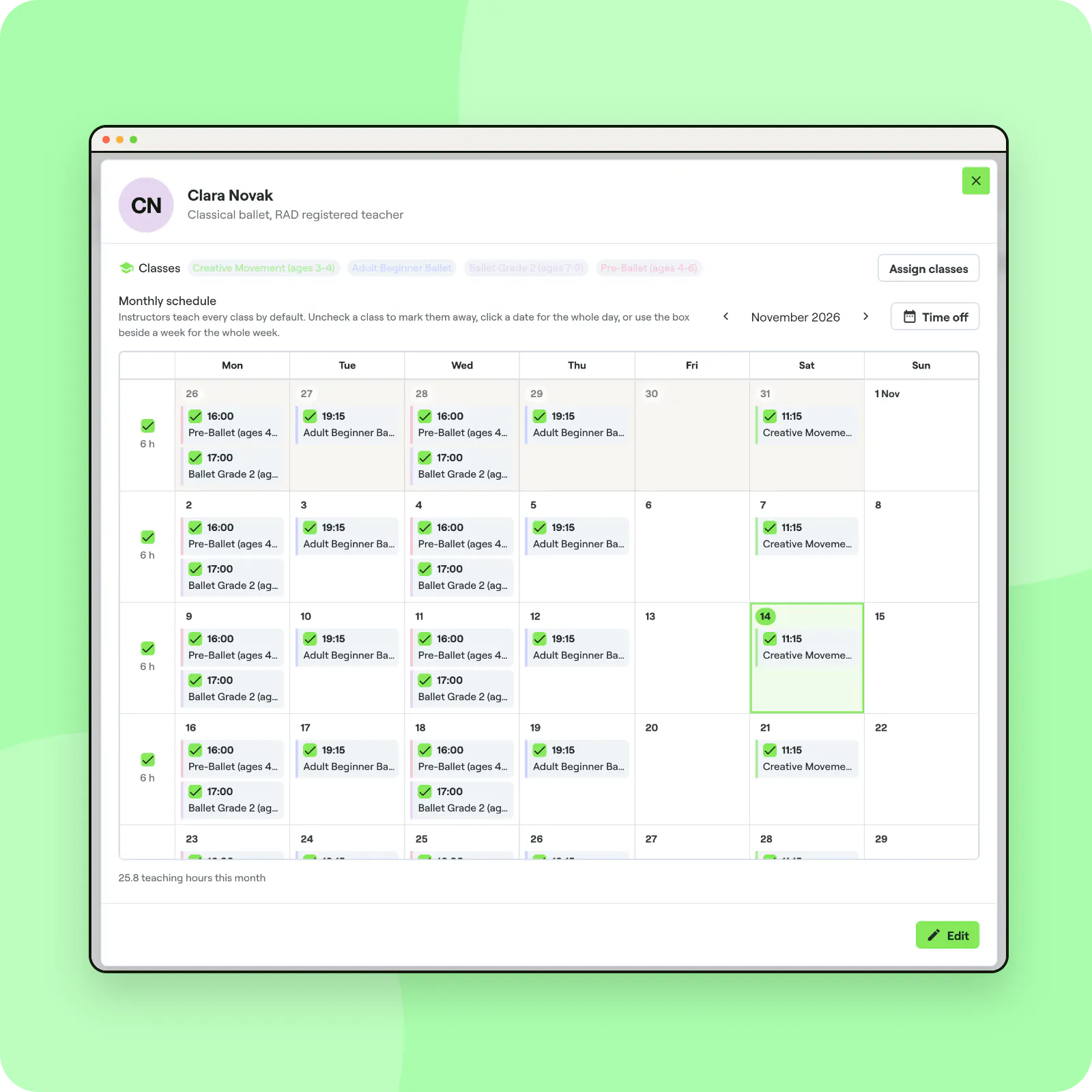
In Stepsi, each teacher's profile shows the classes they teach, their monthly schedule and their teaching hours and time off.
Start with the team you genuinely need and expand as registrations increase. Our guide to managing dance instructors and schedule changes covers the day-to-day side.
10. Create your class programmes and timetable
Your timetable is the foundation of daily studio operations.
Start by choosing a manageable number of classes that match your target market and instructor availability.
For example, a new children's dance school might initially offer:
Day | Time | Programme |
|---|---|---|
Monday | 16:00 | Junior ballet |
Monday | 17:00 | Intermediate ballet |
Wednesday | 16:00 | Children's jazz |
Wednesday | 17:00 | Teen contemporary |
Saturday | 10:00 | Preschool dance |
Saturday | 11:00 | Beginner ballet |
This is only an illustrative timetable.
Choose session times according to local demand, student availability and the programmes you offer.
For each class, define:
- Age range.
- Experience level.
- Duration.
- Instructor.
- Capacity.
- Location.
- Price.
- Registration requirements.
Think carefully about progression.
A beginner student should understand how they can progress towards intermediate and advanced programmes.
Also consider whether you will use term-based enrolment, individual bookings, drop-in sessions or a combination. Our guide to managing online dance class bookings covers bookings and waiting lists in more detail.
A well-designed timetable makes your studio easier to understand and gives you a foundation for future expansion. For a step-by-step approach, see creating your dance class timetable.
With Stepsi's class scheduling, you set up each weekly class once, and the calendar shows who teaches it and how many students are attending.

11. Set your prices and membership options
Your pricing strategy must support your operating costs while remaining suitable for your target market.
Start by calculating the monthly cost of running the business and the minimum number of paying students required to cover expenses.
Consider several payment models:
Payment model | How it works |
|---|---|
Term tuition | Students pay for a fixed number of sessions during a term. |
Monthly memberships | Students pay a recurring fee for access to selected programmes. |
Limited-session packages | Students receive a set number of classes. |
Unlimited memberships | Students can attend eligible classes within defined rules. |
Drop-in payments | Customers pay for individual sessions. |
Private lessons | Students purchase individual coaching sessions or packages. |
You can also introduce family discounts, commitment packages and instalment options where appropriate.
Avoid offering too many memberships at launch.
A small selection of clearly differentiated plans makes it easier for people to understand your pricing.
In Stepsi, each membership plan sets its price, how it renews and whether its sessions are limited or unlimited.

Review your prices against your actual costs and local competitors, and make sure that the margins remain sustainable as the studio grows. For the details, see managing dance studio memberships and setting up recurring dance membership payments.
12. Set up your administration and management systems
One of the biggest mistakes new studio owners make is organising the business through a collection of spreadsheets, messages and paper documents.
This might work when you have ten students, but it becomes increasingly difficult when you have several classes, instructors and payment arrangements.
Set up your administrative processes before the studio becomes busy.
You need a system to manage:
- Student registrations.
- Parent and child accounts.
- Contact information.
- Class schedules.
- Instructor availability.
- Memberships.
- Payments and invoices.
- Class bookings.
- Attendance.
- Agreements and consent.
- Communication.
- Financial reporting.
Think about the complete student journey.
A parent should be able to discover your studio, register their child, select a suitable programme, purchase a membership and access the timetable without requiring several separate administrative interactions.
In Stepsi, an online registration form collects each student's details, the programme they want and a parent or guardian's name in one go.

Choose software that connects these activities rather than forcing your team to maintain different records in several tools.
Consider scalability as well.
A system that works for 30 members should also be capable of supporting a studio with several hundred members.
Our guides to online dance student registration, digital attendance tracking and automating dance studio administration cover these systems in more detail.
Starting a dance studio? Set up your management system from day one
With Stepsi, you can set up your studio account, configure online member registration, create your memberships, publish your timetable and website, and accept online payments before your first class.
Start with the tools you need for your first students, then use the same platform as your dance school grows.
13. Build your website and online registration process
Your website is one of the most important tools for attracting your first students.
Potential customers should be able to understand what you teach, where you are located, who your classes are suitable for and how to register.
Your website should include:
- A clear introduction to your studio.
- Individual dance programme pages.
- Instructor profiles.
- Class timetable.
- Membership and pricing information.
- Contact details.
- Location and directions.
- Frequently asked questions.
- Student testimonials, once available.
- Online registration and booking options.
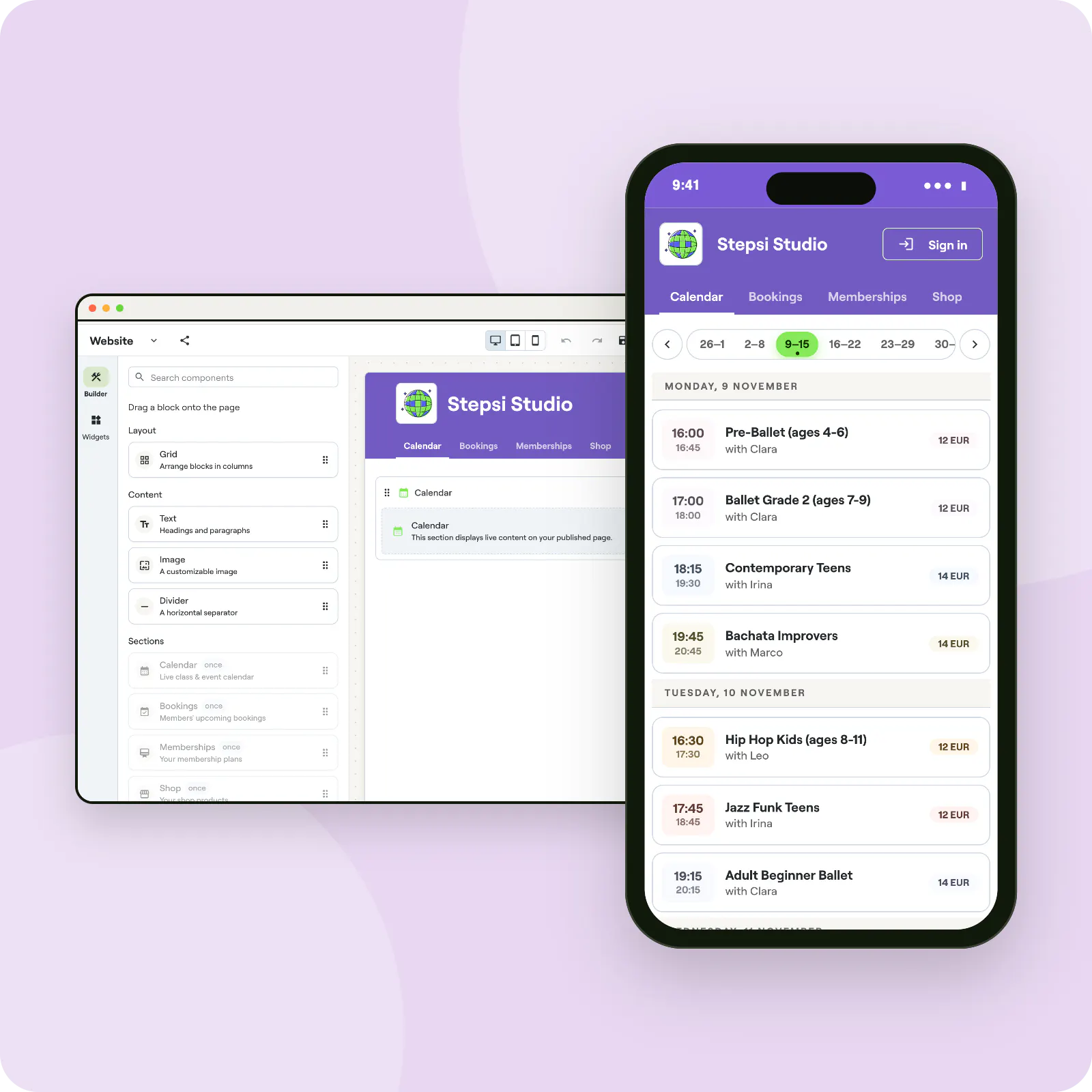
Make sure the website works well on mobile devices.
Also create a Google Business Profile and maintain accurate contact information.
For your registration process, decide which information is required, how parents manage child profiles and whether registrations need approval before students can access the studio's programmes.
Provide a clear confirmation after registration.
A professional online experience helps establish credibility before someone visits your premises. Our guide to building a professional dance studio website goes further.
Publish your studio website with Stepsi
The Stepsi website builder puts your timetable, memberships, online booking and shop on a studio website you edit with drag and drop. Already have a website? Add Stepsi widgets to it instead.
14. Promote your studio and attract your first students
You should start marketing before your official opening date.
Waiting until the studio is ready to teach means missing valuable time when you could already be building awareness and collecting enquiries.
Create a pre-launch marketing plan.
Google Business Profile: Set up your local business presence so people searching for nearby dance classes can discover your school.
Social media: Create Instagram and Facebook accounts. Publish photographs of the studio, instructor introductions, class announcements and behind-the-scenes content.
Local partnerships: Contact schools, nurseries, community organisations and nearby businesses that could introduce your programmes to potential students.
Open days: Organise an introductory event where families can visit the studio, meet instructors and try selected classes.
Trial classes: Offer introductory sessions so prospective students can experience your teaching before committing.
Referral incentives: Encourage your first members to introduce friends and family.
Local advertising: Consider targeted advertising around your studio and the areas you serve.
Create a clear call to action for every campaign, such as booking a trial class or completing an online registration form.
Track enquiries and follow up promptly.
Your first students are especially important because they help establish the atmosphere, reputation and community that future customers will experience. For more ideas, see our guide to attracting your first dance students.
15. Launch, measure performance and grow your dance school
Opening day is only the beginning.
Once your studio starts operating, review the performance of your business regularly.
Track key metrics such as:
- Number of active students.
- New registrations.
- Enquiry-to-registration conversion.
- Class fill rates.
- Attendance.
- Monthly recurring revenue.
- Average revenue per member.
- Membership renewal rates.
- Student cancellations.
- Instructor costs.
- Revenue by class.
- Cash flow and operating expenses.
For example, you might discover that your children's ballet programme is consistently full while adult contemporary classes have available capacity.
This could indicate an opportunity to open another ballet session, adjust the contemporary timetable or invest in more targeted promotion.
Also monitor student retention.
New registrations are important, but a studio that constantly loses members will struggle to grow sustainably. Our guide to improving dance student retention explains how.
Ask for feedback, communicate with parents and make sure instructors are creating an enjoyable learning environment.
As the business develops, consider introducing additional services:
- Private lessons.
- Dance workshops.
- Holiday camps.
- Recitals and performances.
- Merchandise.
- Digital video training.
- Competition programmes.
- Additional studio locations.
Expand when demand and financial performance justify the investment.
A gradual approach helps you grow without introducing unnecessary fixed expenses.
Common mistakes to avoid when starting a dance studio
Do
- Validate demand and understand your finances before making a large property commitment.
- Start with programmes you can fill and deliver consistently.
- Include working capital, not just equipment and property expenses.
- Calculate your break-even point and understand the cost of delivering every programme.
- Match instructor availability and skills to your actual timetable.
- Organise administration early: registration, billing, communication and scheduling can quickly become overwhelming when managed manually.
- Start generating awareness and enquiries before opening.
- Build a positive experience that encourages existing members to remain enrolled.
Avoid
- Signing an expensive lease too early.
- Offering too many classes immediately.
- Underestimating startup costs.
- Setting prices too low.
- Hiring without a clear staffing plan.
- Ignoring administration.
- Launching without a marketing plan.
- Focusing only on new students.
How Stepsi helps you start and manage your dance studio
Starting a dance studio means building more than a teaching timetable. You need systems to manage members, memberships, bookings, instructors, payments and daily communication.
Stepsi provides an all-in-one management platform designed for dance schools and other activity-based businesses.
You can use Stepsi to:
Set up your studio and members
- Create your club and configure its profile.
- Customise the online member registration process.
- Collect and organise student information.
- Manage parents and children through linked family accounts.
- Create online forms and digital agreements.
- Publish a club website using the website builder.
Run classes, memberships and payments
- Create class schedules and multiple calendars.
- Configure instructor profiles and availability.
- Create monthly memberships and term-based tuition.
- Offer unlimited or limited-session plans.
- Manage class bookings and waiting lists.
- Accept online payments through integrated checkout.
- Track attendance through QR code check-in.
Communicate, sell and grow
- Send announcements and communicate with members.
- Build automated welcome and renewal workflows.
- Sell products, workshops and event tickets.
- Manage a video gallery.
- Monitor revenue, attendance and membership analytics.
Stepsi also supports AI-assisted migration, which can help studios moving from another management system or existing spreadsheets.
For a new dance school, you can start by creating your business, setting up your programmes and publishing your membership options, then gradually expand your use of the platform as student numbers grow.
One connected system from your first class
Instead of purchasing separate tools for registrations, payments, scheduling, bookings and communication, you can manage many of these activities within one connected system.
Final thoughts
Starting a dance studio is a rewarding opportunity, but building a sustainable business requires careful planning.
Begin with a clear concept, research your local market and prepare a realistic business plan.
Choose premises that match your financial capabilities, recruit suitable instructors, create a manageable timetable and establish prices that cover your operating costs.
Before launching, make sure you have a professional online presence and a convenient registration process.
Once your classes begin, monitor attendance, revenue, enrolments and retention to understand what is working and where your studio can improve.
Remember that you do not need to build a large dance academy from the first day. You can begin with a small number of well-organised classes, develop a loyal student community and expand when demand supports it.
A successful dance studio is built one class, one student and one relationship at a time. Start with a solid business foundation, and give your dance school the systems it needs to grow.
Frequently asked questions
How much money do I need to start a dance studio?
Startup costs depend on whether you rent an existing room or open a dedicated premises. Consider rent deposits, equipment, flooring, insurance, marketing, staff and working capital. Calculate your costs using actual local quotes before investing. Our free dance studio startup cost calculator adds them up and shows the cash to have at launch.
Do I need to be a professional dancer to open a dance studio?
You do not necessarily need to teach every class yourself. However, you need a solid understanding of the dance education business and access to qualified instructors who can deliver your programmes.
What equipment do I need to open a dance studio?
Typical equipment includes suitable dance flooring, mirrors, sound equipment, ballet barres where required, storage and furniture. The specific requirements depend on the dance styles you offer.
How many students do I need to make a dance studio profitable?
There is no universal number. It depends on your monthly operating costs, average revenue per student, instructor costs and class capacity. Calculate your break-even point using your own financial assumptions.
How do I attract students to a new dance studio?
Start with local SEO, Google Business Profile, social media, trial classes, open days, community partnerships and referrals. Make online registration easy and follow up with prospective students.
Should I rent a studio or hire a room when starting?
Renting an existing room can reduce startup costs and allow you to test demand. A dedicated premises offers greater control but introduces additional fixed expenses and responsibilities.